The Camden Highline was paused last week. After a decade of planning, two design competitions,planning permission granted, and 1,200 donors — the trustees announced it was over, at least for now. Rising construction costs, the 2026 energy shock, charity funders retreating to essentials were given as reasons:
Over the last five years, the UK has experienced a series of sustained economic shocks, with construction costs in particular rising well above general inflation. Until now, these pressures have been factored into the project’s modelling, but the emerging 2026 energy shock represents a further step change.
These same shocks have also affected the wider funding environment. Rising living costs, higher operating costs and increased pressure on charities, public bodies and other partners have reduced the capacity available for discretionary capital projects, as support is increasingly focused on essential and statutory services. Taken together, rising costs and reduced funding capacity mean the project is not currently viable in the present economic climate.
Simon Pitkeathley, Chief Executive of the Camden Highline, said: “this extraordinarily ambitious challenge has, for now, proved a stretch too far”.
Simon was one of the contributors to a BBC radio documentary I produced about urban landscapes post-Covid, called Landscapes of the Mind. In the programme we interviewed James Corner — the New York-based, British landscape architect who designed the original New York High Line. In a subsequent profile for the BBC World Service strand, In the Studio, he explained what he was trying to do: not to copy New York, but to understand what an elevated linear park means in a different city, with different economics, different density, a different relationship between infrastructure and the street. The challenge of Camden was to work with a location that included an active trainline nearby.
“The active train is very different from New York's High Line. What we're trying to do is actually play with that train coming by, with people being able to watch it and experience the movements of trains as they come and go.”
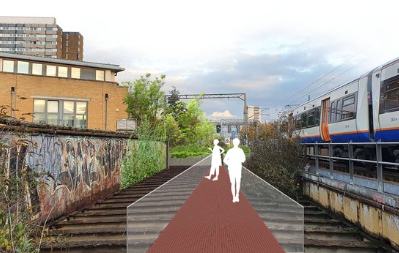
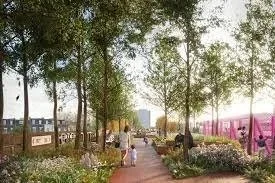
Visualisations of Camden High Line designs.
Corner is a serious thinker about landscape. His argument, in Camden as in New York, was that post-industrial urban space carries a particular kind of latent energy — that the disused railway, the redundant viaduct, the forgotten corridor between neighbourhoods, can become something genuinely democratic in a city that is otherwise running out of public space. The High Line worked in Manhattan because it created a free, accessible, linear experience in one of the most expensive urban environments on earth. That it has since attracted luxury development along its flanks as it expanded into Hudson Yards, which is a complication Corner acknowledges. But he argues that parks are important for cities.
“A park is not just a nice thing to have in a city because it's green and beautiful to look at. A park is fundamental to how the infrastructure of a city functions, how the social fabric of the city be held together.”
Camden was a harder proposition. The economics of the New York High Line depend partly on the scale of surrounding land value uplift — and that model, strained in New York, was already creaking before the UK’s five-year run of economic shocks made it impossible. The energy crisis of 2026 was, as the trustees put it, a step too far.
What the Camden failure actually tells us is something the documentary was already circling: that urban green infrastructure is one of the first casualties of economic pressure, even though the case for it — mental health, air quality, accessible public space in cities of rising inequality — only gets stronger as that pressure intensifies. The people who most need a park like this are the ones who can least afford to wait for the economics to recover.
James Corner’s described cities in the documentary as “ resilient entities” which are always dynamic and evolving.” “You can do great things in cities and you need to think big in order to do that. If we're going to spend all this time and effort, with projects in the city. Let's make them worthwhile. Let's not make them mediocre. Let's not shortchange ourselves.”
You can hear the profile of James Corner here. It remains, I think, a document of what the project imagined itself to be before the reality of building in a post-pandemic, post-energy-shock Britain made it impossible.